tree-service
How Much Does Tree Removal Cost in Oregon? A 2026 Price Guide for Homeowners
Tree removal cost in Oregon for 2026: permit rules, Douglas fir pricing by height, crane fees, regional differences, stump grinding rates, and log value credits.
In This Article
How Much Does Tree Removal Cost in Oregon? A 2026 Price Guide for Homeowners
In Portland, the first cost of taking down a tree is often the permit, not the crew. Removing a private tree above a set trunk diameter requires city review, and depending on the tree you may owe a replanting requirement or a fee in lieu before a saw touches anything.
The removal itself runs $600 to $2,200 for most Oregon residential trees, with a statewide average close to $1,300. Douglas fir over 100 feet, which is ordinary in the Willamette Valley and the Coast Range foothills, routinely runs $2,500 to $6,000.
That gap between an average tree and an Oregon tree is the whole story. Homeowners moving here from other states are used to a 50 foot maple being a big job. In Portland, Eugene, or Corvallis, a 120 foot conifer 30 feet from the house is a normal Tuesday, and it prices accordingly.
Start With the Permit, Not the Quote
Portland's tree regulations cover trees on private property, not just street trees. Removal of a healthy private tree above the size threshold triggers a permit application, and approval often comes with a mitigation planting requirement.
Dead, dying, or hazardous trees follow a different track. Those can usually be removed with a hazard determination, and many companies will document the defect for the application as part of their service.
Street trees in the right-of-way belong to the city. Pruning or removing one without a permit carries a penalty, and the strip between sidewalk and curb is exactly where homeowners assume the tree is theirs.
Other Oregon cities run their own versions. Lake Oswego, Beaverton, Eugene, Ashland, and Bend all have ordinances covering significant or heritage trees, and the thresholds are not the same from one city to the next.
Ask any bidder to handle the permit and include it in the quote. Companies working a city daily know the forms, and the $50 to $500 in fees is small next to the delay of getting it wrong.
What Size Costs in Oregon
A tree under 30 feet runs $350 to $700, and one in the 30 to 60 foot range runs $700 to $1,600. Between 60 and 90 feet the price moves to $1,400 to $3,200.
Above 90 feet you are into the $2,500 to $6,500 band, which is where a large share of Oregon removals land.
Trunk diameter modifies all of it. A 36 inch Douglas fir carries three or four times the wood of a 20 inch one at the same height, and disposal volume is a real line item when a single tree yields eight to ten truckloads of chips and rounds.
Slope changes the number too. Hillside properties in the West Hills, the Tualatin Mountains, and around Ashland make equipment placement difficult, and crews price the extra rigging and hand-carrying accordingly.
Multiple trees in one visit earn a discount of 15 to 30 percent per tree. If you are clearing three firs off a back property line, quote them together rather than one at a time.
Crane Work Is Ordinary Here
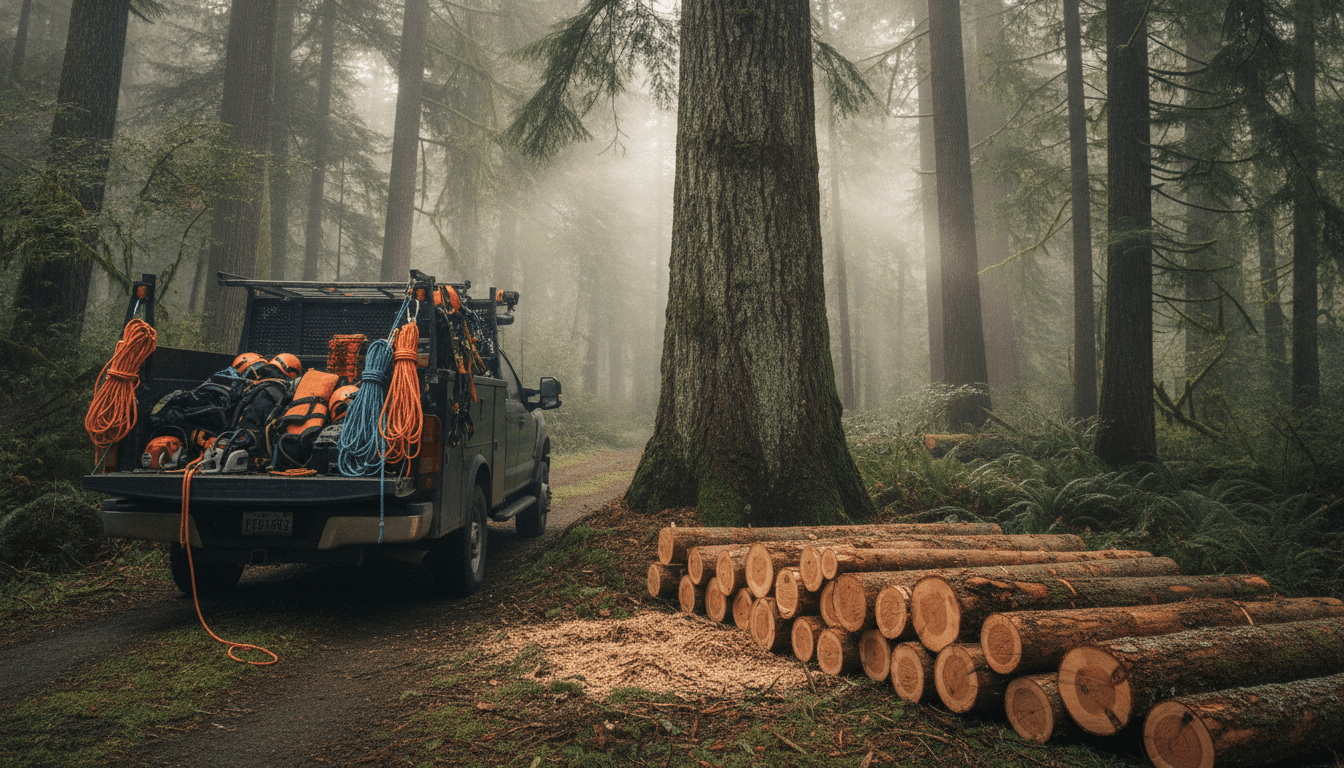
In much of the country a crane is an exception. In western Oregon it is the standard approach for large conifers near structures, because picking sections out vertically is safer and faster than roping them down through a canopy.
Crane time adds $800 to $2,500 to a job. That sounds like a lot until you compare it to two extra days of climbing labor on a 130 foot fir over a roofline.
Access determines whether it is even possible. The crane needs a setup pad within reach of the tree, and narrow Portland streets, overhead utility lines, and steep driveways all rule it out on some properties.
When a crane cannot get in, the price goes up rather than down. Hand rigging a large conifer in a tight yard is the most expensive way to remove a tree in this state.
Wet Soil, Wind, and Trees That Fail in Winter
Oregon loses trees in a specific pattern. Saturated soil in December through February loosens the root plate, then an east wind through the Columbia Gorge or a Pacific storm pushes the tree over whole.
That is why leaning trees deserve attention before winter, not during it. A crew doing scheduled work in August charges standard rates, while the same tree on the ground across your driveway in January is emergency work at 1.5 to 2 times the rate.
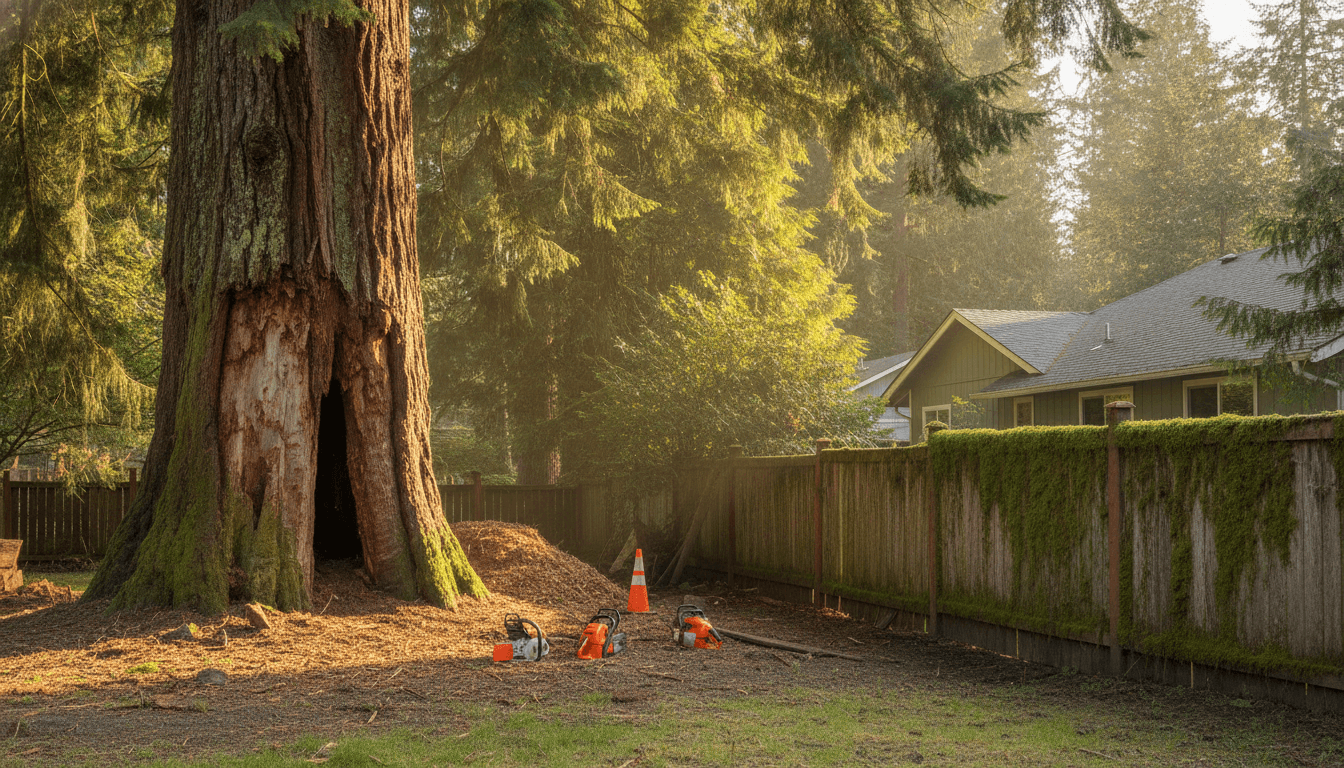
Look at the base of any large conifer near the house. Soil heaving on the opposite side of a lean, exposed roots on the uphill side, or a fresh crack in the ground are all signs the root plate is moving.
Ice storms add a different failure mode. The 2021 Willamette Valley ice event took the tops out of thousands of trees, and topped conifers develop weak regrowth that becomes a hazard years later.
Species That Change the Price
Douglas fir is the most common large removal in Oregon and the most predictable. The wood is heavy, the trunk is straight, and a good crew can work it efficiently once access is solved.
Big-leaf maple is harder. The canopy spreads wide, limbs are heavy and often decayed at the union, and the branch structure forces more individual rigging picks.
Western red cedar has become a growing share of removals. Drought stress through recent dry summers has left many cedars with dead tops and thinning foliage, and a declining cedar near a structure is a removal candidate rather than a pruning one.
Poplar and cottonwood along river bottoms are cheap to cut and expensive to clean up. The wood is light but the volume is enormous, and disposal drives that bill.
Prices Outside the Portland Metro
Eugene and Springfield run about 10 percent below Portland for comparable work. Salem and Corvallis are similar.
Bend and Central Oregon price differently because the trees are different. Ponderosa pine removals there run $600 to $2,000, and defensible space thinning around a home is often quoted by the hour or by the acre rather than per tree.
Southern Oregon around Medford and Grants Pass runs below the valley average, and wildfire fuel reduction is a large part of what crews do. Clearing brush and small-diameter trees within 100 feet of a house runs $1,500 to $6,000 per acre.
Coastal towns pay a premium for travel. Crews often come from the valley, and mobilization to Astoria, Tillamook, or Coos Bay adds $150 to $400 to a job.
Stumps, Wood, and What You Can Recover
Stump grinding runs $3 to $7 per inch of diameter in Oregon with a $125 minimum. A 40 inch fir stump is therefore $150 to $280, and hauling the grindings off adds $75 to $200.
Large conifer stumps sometimes exceed what a small grinder can handle. On a 48 inch stump, expect a larger machine and a price closer to $400.
Log value is the piece Oregon homeowners overlook. A straight, clean Douglas fir or maple butt log has value to a small mill or an urban lumber operation, and some companies will credit part of the removal in exchange for keeping merchantable logs.
Firewood is the other offset. Ask the crew to leave rounds if you burn wood, since paying to haul away three cords of fir and then buying firewood in November makes no sense.
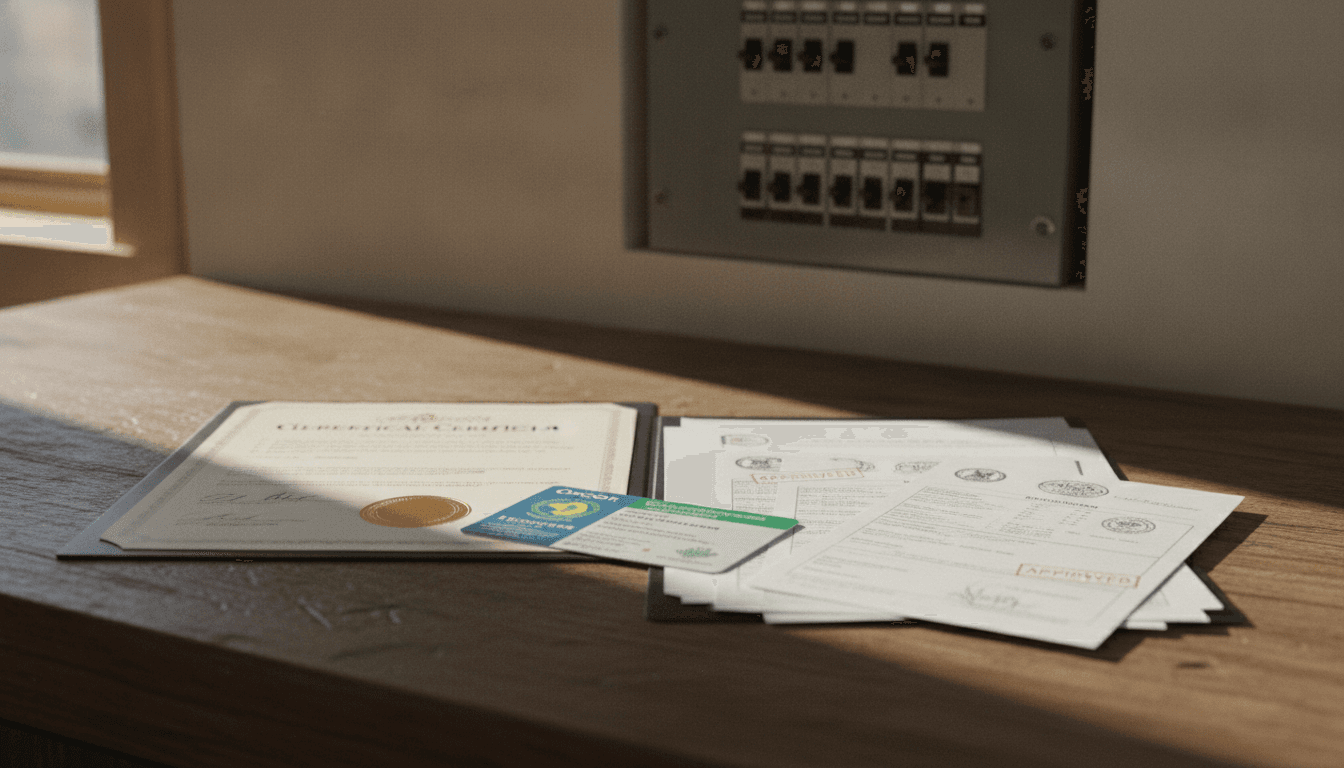
Verify credentials before you sign. Oregon requires tree services to hold a Construction Contractors Board license, and an ISA certified arborist on staff is the marker that separates a real operation from a truck with a saw. Comparing several certified tree service companies is the fastest way to find both.
Trees on a Shared Property Line
Boundary trees create more disputes in Oregon than almost any other tree issue. A trunk straddling the property line belongs to both owners, and neither can remove it without the other's agreement.
Branches and roots crossing onto your side are a different matter. Oregon practice generally allows trimming back to the property line, provided the work does not kill the tree.
Killing a neighbor's tree carries real exposure. Oregon law allows damages for wrongful cutting, and courts have awarded well above the tree's replacement cost in some cases.
Put shared removals in writing. A short signed agreement covering who pays what and who hires the crew avoids a fight halfway through a $3,000 job.
Oregon Tree Removal Questions
Do I need a permit to remove a dead tree?
Usually you still need to file, but hazard and dead tree removals are typically approved without a mitigation planting. Portland and several other cities want documentation from an arborist confirming the condition.
How much does it cost to remove a 100 foot Douglas fir?
Between $2,500 and $5,000 for most residential settings, and above that if a crane is required or access is limited. Open acreage with room to fall the tree whole can drop it under $2,000.
Will homeowners insurance pay for a leaning tree?
Not for preventive removal. Policies generally respond after a tree damages a covered structure, which is why a $1,500 scheduled removal beats waiting for a $30,000 roof claim with a deductible attached.
Is winter cheaper in Oregon?
Less so than in colder states, because winter is the storm season and crews stay busy with emergency work. Late summer through early fall is the value window here, with dry ground and open schedules.
What does an arborist report cost?
Between $250 and $600 for a written assessment. Cities frequently require one for a removal permit, and it is worth having when a neighbor disputes the condition of a shared boundary tree.
Booking large conifer work in dry season, permitting properly, and asking about log credit are the three things that keep Oregon removals from getting out of hand. More Oregon home service cost guides are on our home services blog.